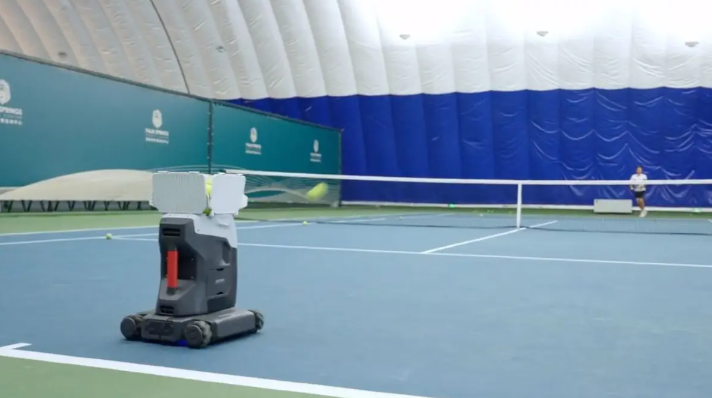
Most tennis players have experienced the limitations of practicing alone. A traditional ball machine can deliver shots, but it can’t see where you’re standing, how you’re recovering after a shot, or whether you’re actually ready for the next ball. That gap between mechanical repetition and real, responsive training is exactly what vision-based systems are designed to close, and it’s the foundation of how the Tenniix Pro operates.
What “Vision-Based” Actually Means in Practice
The term gets used loosely in marketing, so it’s worth being specific. A vision-based training system uses cameras and sensors to track objects and movement in real time — in this case, the player, the ball, and the court itself — rather than simply firing shots on a predetermined loop.
The AI tennis robot at the center of this approach uses dual-camera vision combined with UWB (ultra-wideband) sensing to understand where a player is positioned during a rally. This isn’t just about detecting motion — it’s about building enough spatial awareness to adjust ball delivery based on what’s actually happening on court, shot by shot.
See also: Tekno-Step: Durable Luxury Floors and Smart Design Tools
Why Positional Awareness Changes Training Quality
Traditional ball machines treat every shot the same regardless of where the player is standing or how they’ve recovered from the previous ball. That works fine for pure repetition drills, but it doesn’t reflect how tennis is actually played. Real points involve movement, recovery, and adjustment — and training that ignores this gap only goes so far.
By tracking player position continuously, the Pro can adjust feed placement and timing to reflect more realistic scenarios: forcing recovery after a wide shot, feeding to open court after a lateral movement, or adjusting pace based on how quickly a player returns to position. This turns practice into something closer to responsive rally training rather than static ball feeding.
Adaptive Drills and Opponent Simulation
One of the more advanced capabilities this vision system supports is opponent simulation — sequences designed to mimic how a real player might construct points rather than repeating identical patterns. Combined with shot analysis and performance reporting, this creates a feedback loop that helps players understand not just whether they made contact, but whether their shot selection and court positioning were sound.
For players training without a coach present, this kind of structured, adaptive practice fills a gap that’s traditionally required either a skilled hitting partner or in-person coaching to replicate.
Full-Court Training, Not Just Fixed-Position Drilling
Because the system tracks the full court rather than a single fixed zone, training sessions can extend beyond simple baseline rallying. Full-court drills that involve net play, wide-angle shots, and defensive recovery become possible without needing a second person to feed varied patterns manually.
This matters most for intermediate and advanced players who have already built consistent strokes and need training that challenges movement, anticipation, and shot selection under more realistic conditions — areas where fixed-pattern machines fall short regardless of how many balls they can hold.
Controls and Everyday Usability
Advanced tracking capability only matters if it’s accessible during an actual practice session, which is where app and voice controls come in. Being able to switch drills, adjust intensity, or modify shot patterns without walking back to the machine keeps sessions efficient, especially during high-intensity full-court drills where every reset costs momentum.
Performance reports generated after each session add another layer of value, giving players concrete data to review rather than relying purely on how a session felt in the moment.
How This Fits Into the Broader Tenniix Lineup
The vision-based approach used in the Pro reflects a broader shift happening across the entire training category. As a smart tennis ball machine evolves from simple ball delivery toward genuine training intelligence, features like customizable feeding, adaptive drills, and performance tracking are becoming central to what separates useful training tools from basic equipment.
This progression also explains why vision-based systems tend to appeal most to players who’ve already mastered fundamentals through more straightforward repetition training and are now looking to close specific performance gaps — footwork, recovery speed, or shot selection under pressure — that static drilling simply can’t address.
Who Gets the Most Value From Vision-Based Training
This type of system is best suited for players who already have solid technical fundamentals and want practice that reflects real match conditions rather than isolated shot repetition. Competitive club players, tournament players, and coaches supplementing group lessons with individualized full-court drills are the clearest fit. Beginners still building basic mechanics will likely get more immediate value from simpler, repetition-focused training before layering in adaptive, vision-based features.
Final Thoughts
Vision-based training represents a meaningful step beyond traditional ball machines, moving from fixed-pattern repetition toward responsive, court-aware practice. By tracking player position and adapting feed patterns in real time, this kind of system closes a gap that’s historically only been addressed through live coaching or skilled practice partners — giving serious players a genuinely useful way to train independently at a higher level.
FAQs
1. What makes a training system “vision-based”? It uses cameras and sensors to track the player, ball, and court in real time, allowing the machine to adjust ball delivery based on actual movement rather than a fixed pattern.
2. How does positional tracking improve practice quality? It allows the machine to adjust shot placement and timing based on where the player is standing, creating drills that reflect realistic recovery and movement scenarios instead of static repetition.
3. Is this type of training useful for beginners? Beginners typically benefit more from simpler, repetition-focused practice first. Vision-based, adaptive training is generally more valuable once basic mechanics are already established.
4. Can this system support full-court training, not just baseline drills? Yes. Because it tracks the full court, it can support drills involving net play, wide-angle shots, and defensive recovery rather than limiting practice to a single fixed zone.
5. Does the system provide feedback after a session? Yes. Performance reports are generated after sessions, giving players objective data on shot analysis and drill performance rather than relying solely on subjective impressions.